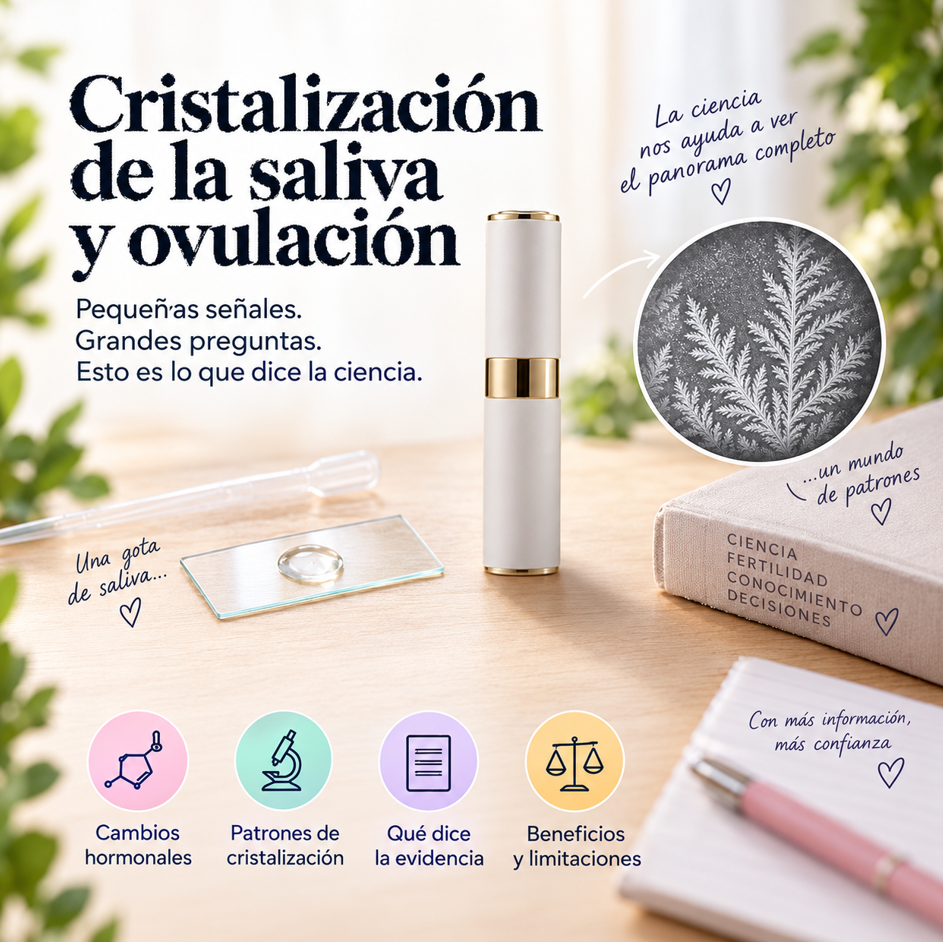
¿Qué es la cristalización de la saliva o «salivary ferning»?
El «salivary ferning» es un patrón ramificado de cristalización que puede aparecer cuando se deja secar una pequeña cantidad de saliva y se observa bajo un microscopio. Su aspecto puede recordar a las hojas de un helecho.
Durante el ciclo menstrual cambian los niveles de diferentes hormonas. Antes de la ovulación, el aumento de estrógenos provoca cambios en la composición y las propiedades de la saliva que pueden influir en la forma en que esta cristaliza al secarse. A medida que se aproxima el periodo fértil, pueden aparecer patrones de cristalización cada vez más definidos y ramificados. Estos cambios pueden observarse mediante un microscopio de saliva.
Esto no significa que el microscopio mida directamente la concentración de estrógenos. Lo que permite observar es el efecto físico en la saliva asociado a los cambios hormonales que tienen lugar durante el periodo fértil.
La idea básica puede resumirse de la siguiente manera:
aumento de estrógenos antes de la ovulación → cambios en la saliva → cambios en el patrón de cristalización → señal indirecta del periodo fértil.
Por ello, los investigadores llevan décadas estudiando la cristalización de la saliva como una posible herramienta para ayudar a identificar el periodo fértil.
El periodo fértil y el momento exacto de la ovulación no son lo mismo
Identificar el periodo fértil no significa determinar el momento exacto en el que el ovario libera el óvulo. Son dos conceptos relacionados, pero diferentes.
La Sociedad Americana de Medicina Reproductiva (ASRM) define el periodo fértil como un intervalo de seis días que termina el día de la ovulación. La probabilidad de concepción es especialmente alta cuando las relaciones sexuales tienen lugar durante los dos días anteriores a la ovulación.
Esta diferencia es especialmente importante para una mujer que desea quedarse embarazada. Para aprovechar el periodo fértil, es más útil reconocer que se está entrando en los días fértiles que conocer el momento exacto en el que se libera el óvulo.
La razón es que los espermatozoides pueden permanecer capaces de fecundar durante varios días en el aparato reproductor femenino. Por ello, las relaciones sexuales antes de la ovulación pueden dar lugar a un embarazo cuando el óvulo se libera posteriormente.
La ASRM señala, de hecho, que el uso de métodos de seguimiento de la fertilidad para identificar el periodo fértil y programar adecuadamente las relaciones sexuales está asociado con una mayor probabilidad de concepción durante el ciclo ovulatorio.
Por eso, al evaluar la cristalización de la saliva, la pregunta más importante es:
¿Pueden los cambios en la cristalización de la saliva asociados al aumento de estrógenos ayudar a reconocer que una mujer está entrando en su periodo fértil?
Precisamente esta es la cuestión que diferentes estudios sobre la cristalización de la saliva han intentado investigar.
Ventana fértil vs. día de ovulación: ¿cuál es la diferencia?
¿Por qué cambia la saliva durante el ciclo menstrual?
Las concentraciones de las hormonas sexuales cambian durante el ciclo menstrual. Uno de los cambios más importantes antes de la ovulación es el aumento de los estrógenos, que acompaña al desarrollo del folículo y precede al aumento de LH y a la ovulación.
Estos cambios hormonales no afectan únicamente a los órganos reproductores. También pueden provocar cambios en diferentes fluidos corporales, incluida la saliva.
Diferentes investigaciones han observado durante el ciclo menstrual cambios en características de la saliva como la concentración de electrolitos, proteínas, enzimas, pH y otras propiedades bioquímicas.
Estos cambios son importantes para comprender la cristalización de la saliva. Cuando una muestra de saliva se seca, las sustancias disueltas en ella pueden formar diferentes estructuras cristalinas. Los cambios asociados al aumento de estrógenos durante el periodo fértil pueden favorecer la aparición de patrones ramificados característicos, conocidos como «ferning».
Por ello, un microscopio de saliva no tiene por qué medir directamente la cantidad de estrógenos en el organismo. Lo que permite observar es la consecuencia física en la saliva asociada a estos cambios hormonales.
El mecanismo puede resumirse de la siguiente manera:
aumento de estrógenos → cambios en la composición de la saliva → cambios en la cristalización durante el secado → patrón visible bajo el microscopio
Esta relación constituye la base biológica para investigar la cristalización de la saliva como una señal indirecta del periodo fértil.
La siguiente pregunta es, por tanto, más práctica: ¿cómo cambian estos patrones cuando se observan bajo el microscopio y qué pueden indicar sobre el momento del ciclo?
¿Qué se observa bajo el microscopio?
Cuando se deja secar una pequeña cantidad de saliva y se observa bajo un microscopio, pueden aparecer diferentes grados de cristalización. Estos patrones pueden cambiar a lo largo del ciclo en función de los cambios hormonales, especialmente del aumento de estrógenos que precede a la ovulación.
De forma simplificada, pueden observarse:
⚪ Cristalización escasa o inexistente
Predominan pequeños puntos o estructuras poco organizadas. Este patrón suele asociarse con periodos del ciclo en los que la influencia de los estrógenos sobre la cristalización de la saliva es menor.
🌿 Cristalización parcial
A medida que aumenta el nivel de estrógenos y se aproxima el periodo fértil, pueden comenzar a aparecer estructuras ramificadas entre las zonas que todavía presentan una cristalización escasa.
🌿🌿 Cristalización más pronunciada
Durante el periodo fértil pueden observarse patrones ramificados más extensos y claramente definidos, con un aspecto característico que recuerda a las hojas de un helecho.
Por ello, no es importante únicamente encontrar «cristales» en la saliva, sino observar cómo cambia el patrón de cristalización en relación con los cambios del entorno hormonal durante el ciclo.
Los dispositivos comerciales pueden utilizar diferentes sistemas para clasificar e interpretar estos patrones. Por ello, al utilizar un microscopio de saliva, deben seguirse las instrucciones específicas del fabricante.
¿Qué han descubierto los estudios sobre el periodo fértil?
Un estudio registró la cristalización de la saliva durante una media de 6,2 días
Uno de los primeros estudios sobre la cristalización de la saliva siguió a 32 mujeres y comparó los patrones observados en la saliva con otros indicadores del periodo fértil.
En 28 de las 32 mujeres, los investigadores observaron un patrón de cristalización de la saliva que correspondía al periodo fértil identificado mediante otros marcadores.
Un hallazgo especialmente interesante fue la duración de este patrón: la cristalización comenzó uno o dos días antes de la aparición del moco cervical fértil y duró una media de 6,2 días.
Este resultado es significativo porque la fertilidad no se limita únicamente al día de la ovulación. Como hemos visto, el periodo fértil abarca varios días y la mayor probabilidad de concepción se concentra alrededor de los días anteriores a la ovulación. Una señal fisiológica que aparece al entrar en este periodo puede proporcionar información útil para decidir cuándo comenzar a mantener relaciones sexuales si se desea un embarazo.
Los autores concluyeron que existía una relación directa entre los patrones de cristalización de la saliva y el periodo fértil observado en el estudio. También señalaron que el método puede utilizarse junto con otros indicadores de fertilidad y que era necesario continuar investigándolo.
¿Existe una relación entre la cristalización de la saliva y la LH?
Sí. Algunos estudios han encontrado una estrecha relación temporal entre los cambios en la cristalización de la saliva y el aumento de LH que precede a la ovulación.
Fehring y Gaska siguieron a 12 mujeres durante dos ciclos y compararon los patrones de cristalización de la saliva con otros indicadores de fertilidad.
Los investigadores encontraron una correlación muy fuerte entre el pico de LH urinaria y el pico de cristalización de la saliva (r = 0,98).
Este resultado es especialmente interesante porque ambos indicadores están relacionados con los cambios hormonales que tienen lugar alrededor del periodo fértil, pero no observan la misma señal.
La cristalización de la saliva está relacionada con los cambios en la saliva provocados por el aumento de estrógenos, mientras que la prueba urinaria detecta el aumento de LH, que aparece más tarde y precede a la ovulación.
Por ello, la fuerte correlación encontrada entre ambos picos respalda la idea de que los cambios visibles en la cristalización de la saliva pueden seguir la progresión hormonal hacia la ovulación y proporcionar información sobre el periodo fértil.
Los investigadores también observaron cierto grado de cristalización en otras partes del ciclo. Por este motivo, resultaba más difícil determinar únicamente a partir de la saliva los límites exactos del inicio y del final del periodo fértil.
¿Qué nos indica este estudio?
El estudio demuestra que la cristalización de la saliva no es un fenómeno aislado del resto del ciclo: su aparición más pronunciada mostró una relación temporal muy estrecha con uno de los principales marcadores hormonales utilizados para detectar la proximidad de la ovulación.
Al mismo tiempo, demuestra por qué resulta útil observar la evolución del patrón a lo largo del ciclo, en lugar de interpretar cada cristalización individual como una señal inequívoca de fertilidad.
¿Qué muestran las investigaciones con un mayor número de mujeres?
Otro estudio relevante comparó un microscopio portátil de saliva con pruebas urinarias de LH en 74 mujeres sanas con ciclos menstruales regulares.
Los investigadores observaron una concordancia entre ambos métodos durante diferentes fases del ciclo menstrual y concluyeron que, en las condiciones estudiadas, tanto el microscopio de saliva como la prueba urinaria de LH pueden ayudar a identificar el periodo fértil.
Un resultado especialmente interesante fue la diferencia temporal entre ambas señales: el patrón de cristalización de la saliva apareció aproximadamente 24 horas antes de la señal positiva de la prueba urinaria de LH.
Esta diferencia tiene una explicación biológica. Ambos métodos están relacionados con la progresión hormonal hacia la ovulación, pero observan diferentes señales de este proceso. La cristalización de la saliva está relacionada con los cambios en la saliva provocados por el aumento de estrógenos, mientras que la prueba urinaria detecta el aumento posterior de LH que precede a la ovulación.
Por ello, la señal más temprana de la saliva resulta especialmente interesante cuando el objetivo es reconocer la entrada en el periodo fértil, y no únicamente detectar una señal hormonal muy cercana a la ovulación.
Los resultados de este estudio respaldan así la investigación de la cristalización de la saliva como una señal fisiológica indirecta que puede proporcionar información sobre el periodo fértil y su aproximación a la ovulación.
Fuente: Günther V, et al. PMID: 26319654.
¿Qué dicen las investigaciones más recientes?
La investigación sobre la cristalización de la saliva no se limita a los primeros estudios realizados hace varias décadas. En 2025, un estudio con 42 mujeres con infertilidad idiopática evaluó un dispositivo portátil moderno basado en la cristalización de la saliva y comparó sus resultados con pruebas urinarias de ovulación y foliculometría.
Según la definición utilizada por los investigadores —según la cual un resultado positivo puede indicar ovulación o periodo fértil—, el dispositivo mostró una sensibilidad del 97,4 % y una precisión del 97,6 %.
Estos resultados proporcionan evidencia más reciente de que los patrones de cristalización de la saliva pueden utilizarse para obtener información sobre los cambios asociados al periodo fértil cuando se observan e interpretan mediante un dispositivo diseñado para este propósito.
El estudio también resulta interesante porque no evaluó la saliva únicamente en relación con otro método doméstico: utilizó foliculometría, que permite seguir el desarrollo de los folículos ováricos mediante ecografía, además de pruebas urinarias.
Los resultados son prometedores, aunque se refieren a 42 mujeres con infertilidad idiopática y a un dispositivo concreto, por lo que los valores de sensibilidad y precisión obtenidos corresponden a las condiciones y al método evaluados en este estudio.
Fuente: Kolomiichenko TV, et al. (2025). PMID: 40847853.
Entonces, ¿puede la saliva ayudar a identificar el periodo fértil?
Sí. La evidencia disponible indica que los cambios en la cristalización de la saliva pueden proporcionar información útil para reconocer el periodo fértil.
La explicación biológica parte de los cambios hormonales que preceden a la ovulación. El aumento de estrógenos provoca cambios en la saliva que pueden modificar la forma en que esta cristaliza al secarse. Al observar estos patrones durante el ciclo, es posible obtener una señal indirecta de los cambios fisiológicos relacionados con la proximidad de la ovulación.
Los estudios que hemos revisado proporcionan diferentes partes de la evidencia: la cristalización se observó durante varios días del periodo fértil, se identificó una fuerte relación temporal entre el pico de cristalización y el pico de LH, y en algunas investigaciones la señal de la saliva apareció antes del resultado positivo de la prueba urinaria de LH.
Además, investigaciones más recientes con dispositivos modernos han mostrado resultados prometedores cuando la cristalización de la saliva se comparó con otros métodos de seguimiento de la fertilidad, incluida la foliculometría.
Por ello, la observación de la saliva resulta especialmente interesante para una mujer que desea quedarse embarazada: el objetivo no es necesariamente identificar un único momento de la ovulación, sino reconocer con suficiente antelación que está entrando en los días en los que existe posibilidad de concepción.
Los resultados varían entre estudios, dispositivos y poblaciones, por lo que la cristalización de la saliva debe considerarse un indicador fisiológico indirecto del periodo fértil, y no una medición directa de la concentración de estrógenos.
Saliva o prueba de LH: ¿qué es mejor?
Ambos métodos pueden ayudar a reconocer el periodo fértil, pero utilizan diferentes señales de los cambios hormonales que conducen a la ovulación.
🧪 Prueba urinaria de LH
La prueba urinaria detecta el aumento de la hormona luteinizante (LH). Este aumento se produce cerca de la ovulación y proporciona una señal de que esta se aproxima.
Según la ASRM, después de detectar el aumento de LH en la orina, la ovulación puede producirse en cualquier momento durante los dos días siguientes. Por ello, la prueba de LH resulta especialmente útil para reconocer una señal hormonal relativamente cercana a la ovulación.
Para cada medición se necesita una nueva tira reactiva y una muestra de orina.
🔬 Microscopio de saliva
El microscopio de saliva utiliza otra señal relacionada con la progresión hormonal hacia la ovulación. El aumento de estrógenos que se produce durante el desarrollo del periodo fértil provoca cambios en la saliva que pueden observarse a través de sus patrones de cristalización.
Por ello, el microscopio no mide directamente la concentración de estrógenos: observa el efecto físico asociado a estos cambios hormonales y permite seguir la evolución del patrón de la saliva a medida que se aproxima la ovulación.
Algunos estudios han observado que esta señal puede aparecer antes del aumento de LH que puede detectarse en la orina. En el estudio realizado con 74 mujeres que hemos mencionado anteriormente, el patrón de la saliva apareció aproximadamente 24 horas antes de la señal positiva de LH.
Además, cuando se utiliza un dispositivo reutilizable, pueden realizarse observaciones repetidas durante el ciclo sin necesidad de una nueva tira reactiva cada vez.
Entonces, ¿cuál elegir?
No son dos versiones de la misma prueba y no responden exactamente a la misma pregunta.
La prueba urinaria de LH es especialmente útil cuando se desea detectar el aumento de LH que se produce cerca de la ovulación.
El microscopio de saliva puede resultar especialmente interesante cuando se desea seguir la progresión hacia el periodo fértil y reconocer los cambios asociados al aumento de estrógenos que pueden comenzar antes de la señal urinaria de LH.
Para una mujer que desea quedarse embarazada, esta diferencia temporal puede ser significativa: reconocer antes la entrada en el periodo fértil proporciona más tiempo para mantener relaciones sexuales durante los días anteriores a la ovulación, que forman parte del periodo en el que puede producirse la concepción.
Por ello, la elección depende del tipo de información que se desea obtener, del momento en que se desea obtenerla y del método de seguimiento que resulte más práctico para cada persona.
Métodos para detectar la ovulación: test LH, moco cervical, temperatura basal y saliva
¿Qué ventajas prácticas ofrece la observación de la saliva?
Además de la información que puede proporcionar sobre el periodo fértil, la observación de la cristalización de la saliva ofrece varias ventajas prácticas para el seguimiento del ciclo.
🔄 Puede utilizarse varias veces
Un microscopio de saliva reutilizable permite realizar observaciones repetidas durante el ciclo sin necesidad de una nueva tira reactiva cada vez. Esto facilita el seguimiento de la evolución del patrón durante varios días, especialmente cuando se aproxima el periodo fértil.
💧 Utiliza una muestra de saliva
La observación se realiza mediante una pequeña cantidad de saliva, por lo que no es necesario recoger una muestra de orina. Esto permite integrar fácilmente la observación en la rutina de seguimiento del ciclo.
👀 Observa una señal fisiológica del ciclo actual
Esta es una diferencia importante con respecto a los calendarios y algunas aplicaciones que estiman los días fértiles principalmente a partir de las fechas y la duración de los ciclos anteriores.
La cristalización de la saliva, por otro lado, permite observar un efecto físico asociado a los cambios hormonales que tienen lugar durante el ciclo actual. Esto puede ser especialmente importante porque el día de la ovulación no tiene por qué ser exactamente el mismo en todos los ciclos.
📆 Permite seguir la evolución del patrón durante varios días
La cristalización de la saliva no tiene por qué interpretarse necesariamente a partir de una sola observación. El uso repetido permite ver cómo cambia el patrón desde una cristalización débil o inexistente hasta estructuras más ramificadas y claramente definidas a medida que se aproxima el periodo fértil.
De esta manera, el seguimiento se centra en la evolución del patrón, y no únicamente en una fecha calculada mediante un calendario.
🧭 Puede combinarse con otras señales de fertilidad
La observación de la saliva también puede formar parte de un seguimiento más amplio del ciclo. Puede combinarse con información como las fechas del ciclo, los cambios en el moco cervical o las pruebas de LH, proporcionando otra señal fisiológica para comprender mejor cuándo se aproxima el periodo fértil.
¿Puede ser útil seguir varios ciclos?
Sí. Observar la cristalización de la saliva durante varios ciclos puede ayudarle a familiarizarse con la forma en que cambian sus patrones personales antes y durante el periodo fértil.
Con el tiempo puede aprender a reconocer:
- cuándo suelen comenzar a aparecer cambios en la cristalización;
- cómo evoluciona el patrón hacia formas más ramificadas;
- cuánto tiempo suele mantenerse este patrón;
- si su evolución es similar o diferente entre ciclos;
- cómo coincide su evolución con otras señales de fertilidad, como el moco cervical o la prueba de LH.
Esto puede ser especialmente útil porque la ovulación no tiene por qué producirse exactamente el mismo día en todos los ciclos. Observar una señal fisiológica del ciclo actual permite añadir información a las estimaciones que se basan exclusivamente en fechas anteriores.
La repetición por sí sola no hace que el método sea automáticamente más preciso, pero puede proporcionar algo diferente: un contexto personal y familiaridad con la forma en que sus patrones aparecen y evolucionan con el tiempo.
¿La ovulación ocurre siempre el mismo día del ciclo?
¿Dónde encaja Maybe Baby?
Maybe Baby es un microscopio de saliva reutilizable, diseñado para ayudar a identificar el periodo fértil mediante la observación de los cambios en los patrones de cristalización de la saliva a lo largo del ciclo.
Su funcionamiento se basa precisamente en el fenómeno descrito en este artículo. El aumento de estrógenos que precede a la ovulación provoca cambios en la saliva que pueden modificar su patrón de cristalización al secarse. Maybe Baby permite observar estos cambios bajo el microscopio y seguir la evolución del patrón durante el ciclo.
Por ello, Maybe Baby no mide directamente la concentración de estrógenos. Utiliza el efecto físico asociado a estos cambios hormonales como una señal indirecta que puede ayudar a reconocer cuándo se aproxima el periodo fértil.
Maybe Baby reúne varias características prácticas para este tipo de seguimiento:
🔬 permite observar los patrones de cristalización mediante un microscopio
💧 utiliza una pequeña cantidad de saliva
🔄 puede utilizarse varias veces
📆 permite realizar observaciones repetidas y seguir la evolución del patrón durante el ciclo
🏠 está diseñado para uso doméstico
Para una mujer que está intentando quedarse embarazada, la finalidad práctica es especialmente importante: reconocer que está entrando en su periodo fértil y obtener información que le permita decidir cuándo mantener relaciones sexuales.
Esto tiene sentido desde el punto de vista biológico porque la posibilidad de concepción no comienza el día de la ovulación. El periodo fértil abarca varios días y las mayores probabilidades de concepción se producen durante los días inmediatamente anteriores a la ovulación.
Como hemos visto, algunos estudios sobre la cristalización de la saliva observaron patrones relacionados con la fertilidad durante varios días y, en una investigación, la señal de la saliva apareció aproximadamente 24 horas antes de la señal positiva de LH en la orina.
Por ello, el posible valor de este tipo de seguimiento no reside únicamente en observar el patrón de cristalización, sino en utilizar los cambios visibles en la saliva como información sobre la progresión hacia el periodo fértil.
Maybe Baby: cómo funciona para identificar los días fértiles
¿Qué puede esperar razonablemente de Maybe Baby?
Maybe Baby puede ayudarle a observar cómo cambian los patrones de cristalización de su saliva durante el ciclo y utilizar estos cambios como una señal indirecta de la proximidad del periodo fértil.
En la práctica, puede ayudarle a:
- reconocer cambios en la cristalización de la saliva asociados al aumento de estrógenos que precede a la ovulación;
- identificar la progresión hacia el periodo fértil, observando cómo evoluciona el patrón durante varios días;
- obtener información sobre el ciclo que está teniendo lugar actualmente, en lugar de depender exclusivamente de fechas calculadas a partir de ciclos anteriores;
- decidir cuándo mantener relaciones sexuales durante los días en los que existe posibilidad de concepción;
- realizar observaciones repetidas utilizando el mismo dispositivo reutilizable;
- combinar esta información con otras señales, como las fechas del ciclo, el moco cervical o las pruebas de LH.
El objetivo del dispositivo Maybe Baby no es únicamente mostrar cristales bajo el microscopio. Su utilidad reside en interpretar cómo cambia este patrón en relación con los cambios hormonales asociados al periodo fértil.
¿Puede la identificación del periodo fértil ayudar si desea quedarse embarazada?
Sí. Saber cuándo se aproxima y cuándo comienza el periodo fértil puede ayudarle a decidir cuándo mantener relaciones sexuales si está intentando quedarse embarazada.
La concepción no depende únicamente de mantener relaciones sexuales el día de la ovulación. Los espermatozoides pueden permanecer capaces de fecundar durante varios días en el aparato reproductor femenino, por lo que las relaciones sexuales antes de la ovulación pueden dar lugar a un embarazo cuando el óvulo se libera posteriormente.
Por ello, reconocer que está entrando en el periodo fértil puede ser más útil que intentar acertar un único día:
Reconocer la proximidad del periodo fértil
↓
Mantener relaciones sexuales durante los días fértiles, incluidos los días anteriores a la ovulación
↓
Aprovechar el periodo del ciclo en el que existe una mayor posibilidad biológica de concepción
La ASRM señala que mantener relaciones sexuales cada uno o dos días durante el periodo fértil proporciona la mayor eficiencia reproductiva, aunque mantener relaciones sexuales dos o tres veces por semana ofrece resultados casi equivalentes.
Por ello, una señal que ayude a reconocer con antelación la entrada en el periodo fértil puede proporcionar información práctica para decidir cuándo comenzar a intentar la concepción.
Fuentes y evidencia científica
American Society for Reproductive Medicine (ASRM). Optimizing natural fertility: a committee opinion. Fertility and Sterility. 2022. Esto confirma el periodo fértil de seis días, el momento de las relaciones sexuales y el contexto del seguimiento de la fertilidad.
Barbato M, et al. A new diagnostic aid for natural family planning. PMID: 8147248. Estudio con 32 mujeres en el que se observó en 28 mujeres que el ferning correspondía con otros marcadores de fertilidad; la duración media fue de 6,2 días.
Fehring RJ, Gaska N. Evaluation of the Lady Free Biotester in determining the fertile period. PMID: 9673839. Se encontró una fuerte correlación entre el pico del ferning salival y la LH urinaria, junto con ciertas dificultades para determinar los límites del periodo fértil.
Guida M, et al. Efficacy of methods for determining ovulation in a natural family planning program. PMID: 10560997. Evidencia contrapuesta importante cuando el resultado final fue el día de la ovulación determinado mediante ecografía.
Kolomiichenko TV, et al. Effectiveness of using ferning of the dried saliva crystallization to determine the fertile window in women with idiopathic infertility. 2025. PMID: 40847853. Estudio más reciente y prometedor, aunque pequeño y específico para un dispositivo concreto.
Información médica
Este artículo tiene una finalidad educativa y no constituye un sustituto del asesoramiento, diagnóstico o tratamiento por parte de un profesional sanitario. Los métodos domésticos de seguimiento de la fertilidad proporcionan diferentes tipos de información y presentan distintas limitaciones. Si tiene dificultades para concebir, ciclos muy irregulares u otras preguntas relacionadas con la salud reproductiva, consulte con un profesional sanitario.
¿Cómo utiliza Maybe Baby la saliva?
Descubre cómo funciona el microscopio reutilizable Maybe Baby, cómo se interpretan sus patrones y cuáles son las limitaciones del método.
Conocer Maybe Baby